Measuring Efficiency in the AI-Driven SDLC

Summary
- AI collapsed the cost of producing code. Review, testing, and deployment run at the same speed, creating a lopsided SDLC where gains stall before production.
- Agentic AI pull requests wait 5.25x longer for pickup than human-written ones, per LinearB's 2026 Software Engineering Benchmarks Report (8.1M PRs).
- 45% of AI-generated code samples introduce known OWASP Top 10 vulnerabilities, per Veracode's 2025 GenAI Code Security Report (100+ LLMs tested).
- Cycle time (coding, pickup, review, deploy) shows where the SDLC is stalling. Change failure rate confirms speed gains are not costing quality.
AI-driven SDLC efficiency is the degree to which an engineering organization’s full software delivery lifecycle improves in speed and reliability as AI tools are adopted. High efficiency means that gains at the code-creation layer propagate through the entire delivery pipeline, not just accumulate in output metrics.
Why effort-based AI metrics fail your board
Effort-based metrics count how much your team is doing rather than what the system is producing. Adoption rates, token consumption, seats activated, code volume, and developer survey scores all fall into this category, and all of them break down under executive scrutiny for the same reason: they answer the wrong question.
Adoption rates measure activity, not value. A developer who logs into GitHub Copilot every morning is producing telemetry, not necessarily better software. Token consumption rewards waste: the more tokens a developer burns, the higher the metric climbs, which is exactly why tokenmaxxing leaderboards became a problem inside engineering organizations. Your CFO has read about those leaderboards. Quoting token consumption as a positive signal in 2026 sounds, to an executive who has done their reading, like an admission that the wrong thing is being measured.
Developer surveys tell you how engineers feel, which matters. They do not show the impact of organizational inefficiencies, and on their own they do not survive an executive who wants to see system results. Surveys are a useful input to a measurement model, not its centerpiece.
The deeper issue is the difference between an output question and a system question. Whether developers are individually more productive is an output question. Whether the engineering organization got more efficient is a system question. A team composed of more productive individuals can still produce a less efficient system, because individual gains get absorbed by review queues, testing debt, security findings, and stalled work that never makes it to production. For more on what makes AI-era productivity measurement work, read LinearB’s analysis on measuring the impact of Copilot and Cursor on engineering productivity.
Download your free copy of the guide
What AI actually changed across your SDLC
AI collapsed the cost of producing code while leaving everything downstream running at the same speed it always has. Code review, testing, security validation, and deployment did not get faster. The system is lopsided, not faster overall, and the lopsidedness is where your efficiency is disappearing.
According to the 2025 DORA Report, AI amplifies existing engineering conditions. Strong engineering systems get stronger when AI is added, and weak engineering systems get faster at producing bad output. AI does not change the fundamentals of the system; it magnifies them. That finding has a direct implication for the executive conversation: your job is to make the system visible so you can explain where AI is working and where the next investment needs to go.
Code reviews are stalling
According to LinearB’s analysis of more than 8.1 million pull requests across 4,813 teams, AI-assisted pull requests are 2.6x larger than human-written ones. Agentic AI pull requests sit idle 5.25x longer before a reviewer picks them up. Code is being produced faster than the review process can absorb it, and pull requests are queuing up unreviewed.
Reviewers are not faster than they were a year ago. They are now facing larger, more numerous pull requests with less context and a higher rate of subtle issues. A smaller percentage of code that enters the review queue is making it through to production.
Security findings are accumulating
According to Veracode’s 2025 GenAI Code Security Report, tested across more than 100 large language models on security-sensitive coding tasks, 45% of AI-generated code samples introduce known OWASP Top 10 vulnerabilities. That pass rate has not improved across multiple testing cycles. A 2026 industry survey of cybersecurity practitioners found that two-thirds now spend more than half their time validating security findings rather than resolving the underlying vulnerabilities. Exposing secrets ranked as the top concern AI-assisted coding introduced or amplified.
Deployment instability is rising
The 2025 DORA Report found that AI increases throughput while also increasing instability. Teams that report individual productivity gains from AI are also reporting more deployment failures, longer recovery times, and more work that starts, stalls, and never reaches production. Throughput at the top of the system increases while throughput at the bottom stays flat or declines.
What to do next: map the four stages of your delivery pipeline (code creation, review, security/testing, deployment) and measure where work is accumulating. That is where AI-era efficiency measurement starts.
Download your free copy of the guide
The APEX framework: measuring the system, not the activity
APEX is LinearB’s measurement model for engineering productivity in the AI era. It gives you a system-level framework to use in executive conversations about whether your AI investments are producing results. APEX stands for AI leverage, Predictability, Efficiency, and Developer experience. Together, the four pillars describe whether your engineering system is improving overall rather than only at the activity layer.
The framework is designed for the executive conversation, not the sprint review. Each pillar maps to a question executives are actually asking, with metrics that connect engineering behavior to business outcomes. For a deeper look at how the framework was built, see LinearB’s AI Measurement Framework.
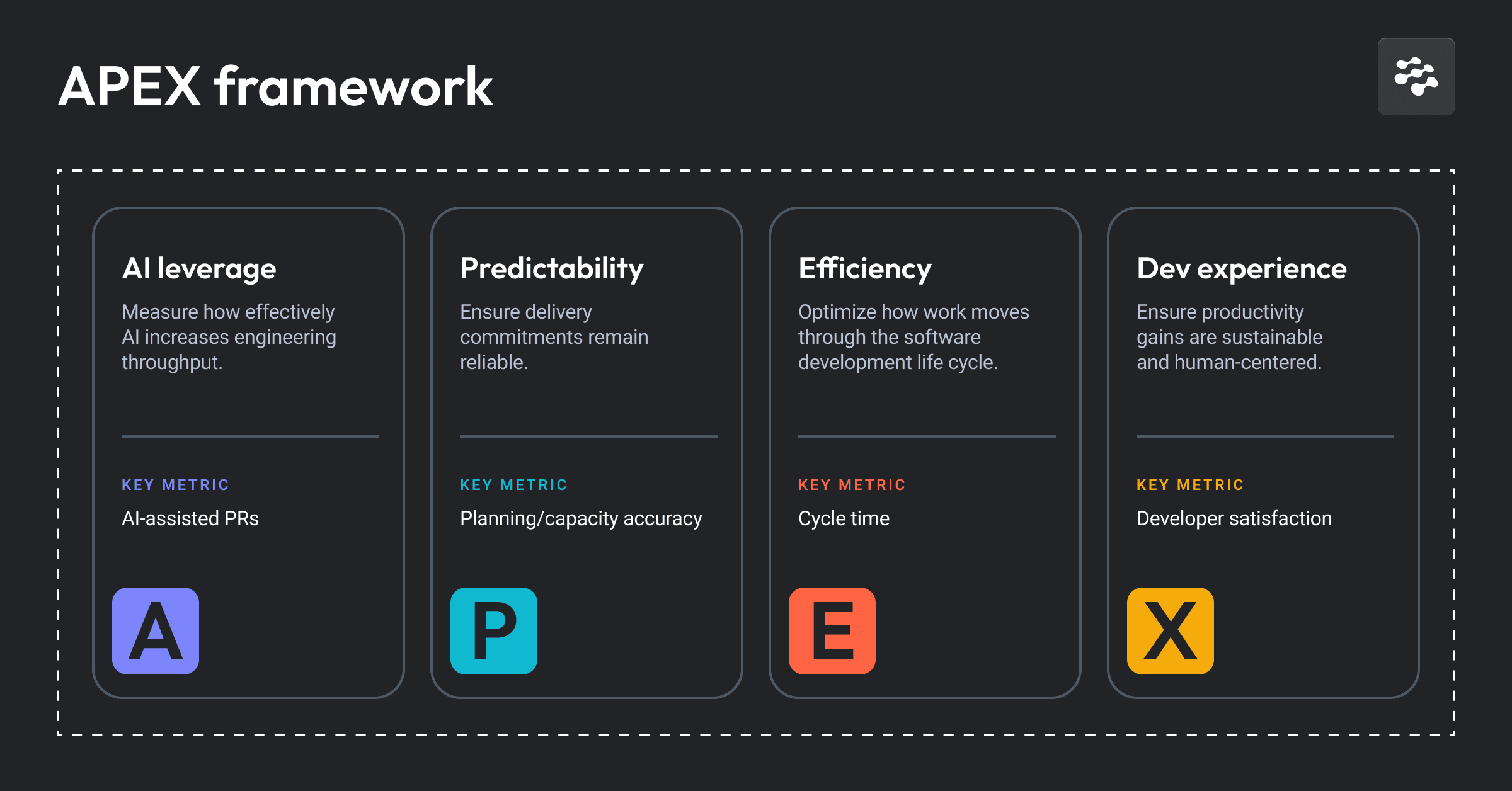
A: AI leverage
AI leverage measures whether AI investments translate into delivery improvement. The key metric is AI-assisted PR rate, but the more important question is what happens to those pull requests downstream: are they getting reviewed at the same speed as human-written ones, or are they creating a review backlog? AI leverage tracks adoption quality, not just adoption volume.
P: Predictability
Predictability measures how reliably your teams deliver what they committed to, including project health and forecast accuracy. When AI is accelerating code production but delivery dates are still slipping, the predictability pillar shows you where the gap is. Planning accuracy and capacity accuracy are the key metrics.
E: Efficiency
Efficiency measures how well work flows through your delivery system, including speed, throughput, and cycle time. Cycle time and change failure rate are the key metrics. Efficiency is where most teams start, because it produces a quick benchmark for the current state of your delivery system without requiring a survey program or a planning overhaul.
X: Developer experience
Developer experience measures how engineers feel about their work and whether their experience contributes positively to productivity. Developer satisfaction is the key metric. The friction that shows up in your cycle time breakdown is often the same friction that burns developers out, so pairing efficiency metrics with developer feedback keeps the gains sustainable.
Download your free copy of the guide
Efficiency: where to start your measurement
Cycle time measures how long it takes work to move from start to finish. It is the clearest single indicator of how smoothly your delivery system runs, and it breaks down into four parts you can measure independently to identify which component is holding your teams back. Use LinearB’s engineering metrics platform to track all four stages in a single view alongside change failure rate.
- Coding time: how long a developer spends writing the code
- Pickup time: how long a pull request waits before someone starts reviewing it
- Review time: how long the review itself takes
- Deploy time: how long merged code waits before reaching production
Change failure rate is the counterweight to cycle time. Cycle time tells you how fast work moves; change failure rate tells you whether you are moving fast at the expense of quality. Change failure rate measures the percentage of deployments that result in failures requiring remediation, such as rollbacks, hotfixes, or patches. Combined, cycle time and change failure rate describe a system that is getting faster without getting more fragile, which is exactly the claim your executives want substantiated.
As AI is applied across more of your SDLC, efficiency is how you confirm you are not trading speed and quality for raw output volume.
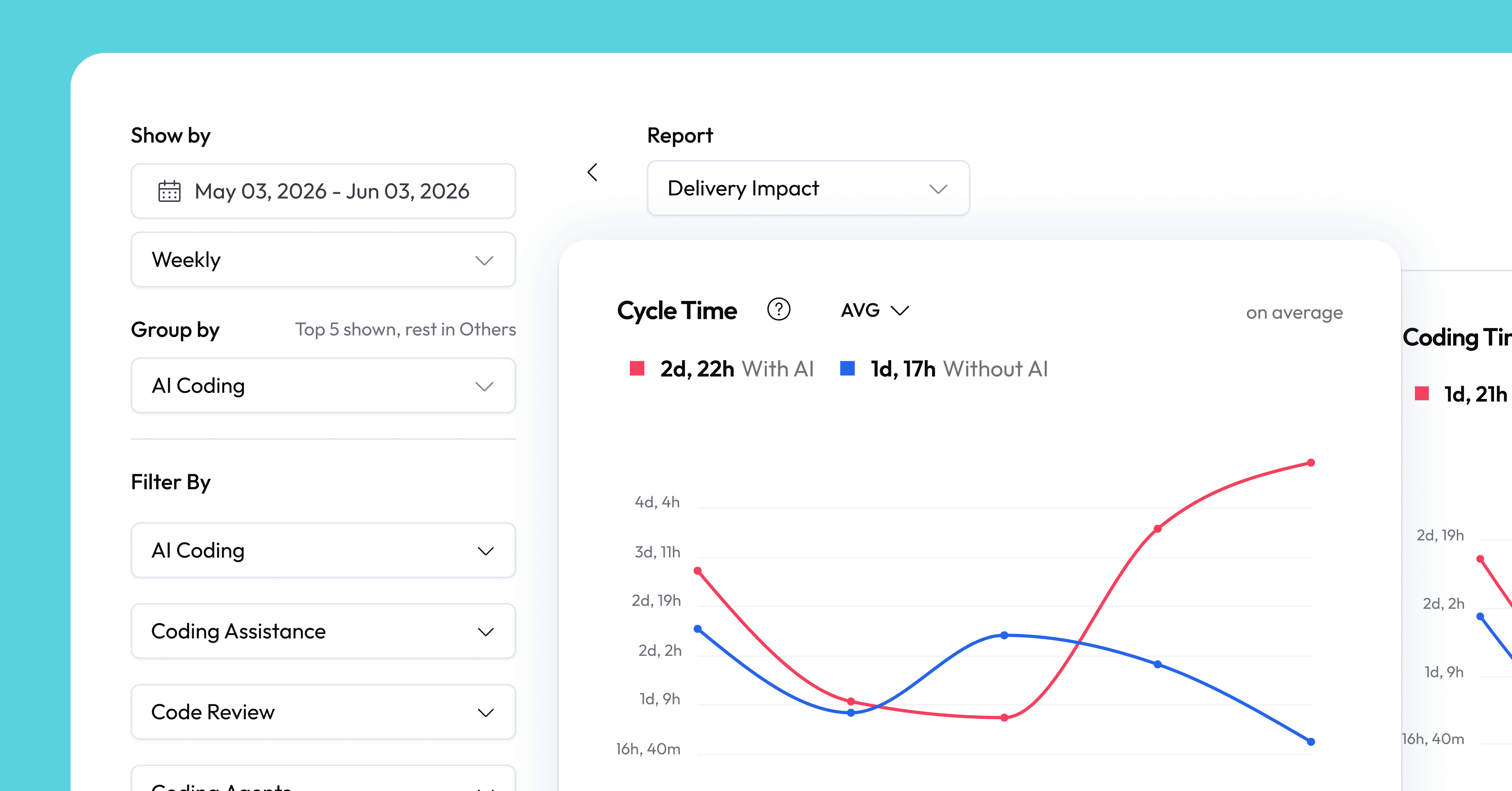
Cycle time benchmarks from 8.1 million pull requests
According to LinearB’s analysis of 8,109,244 pull requests across 4,813 teams and 163,820 active contributors, elite-performing engineering organizations hit the following cycle time targets. Use these benchmarks to identify which stage of your delivery pipeline is underperforming relative to peers. For the full benchmark dataset, see LinearB’s engineering productivity benchmarks.
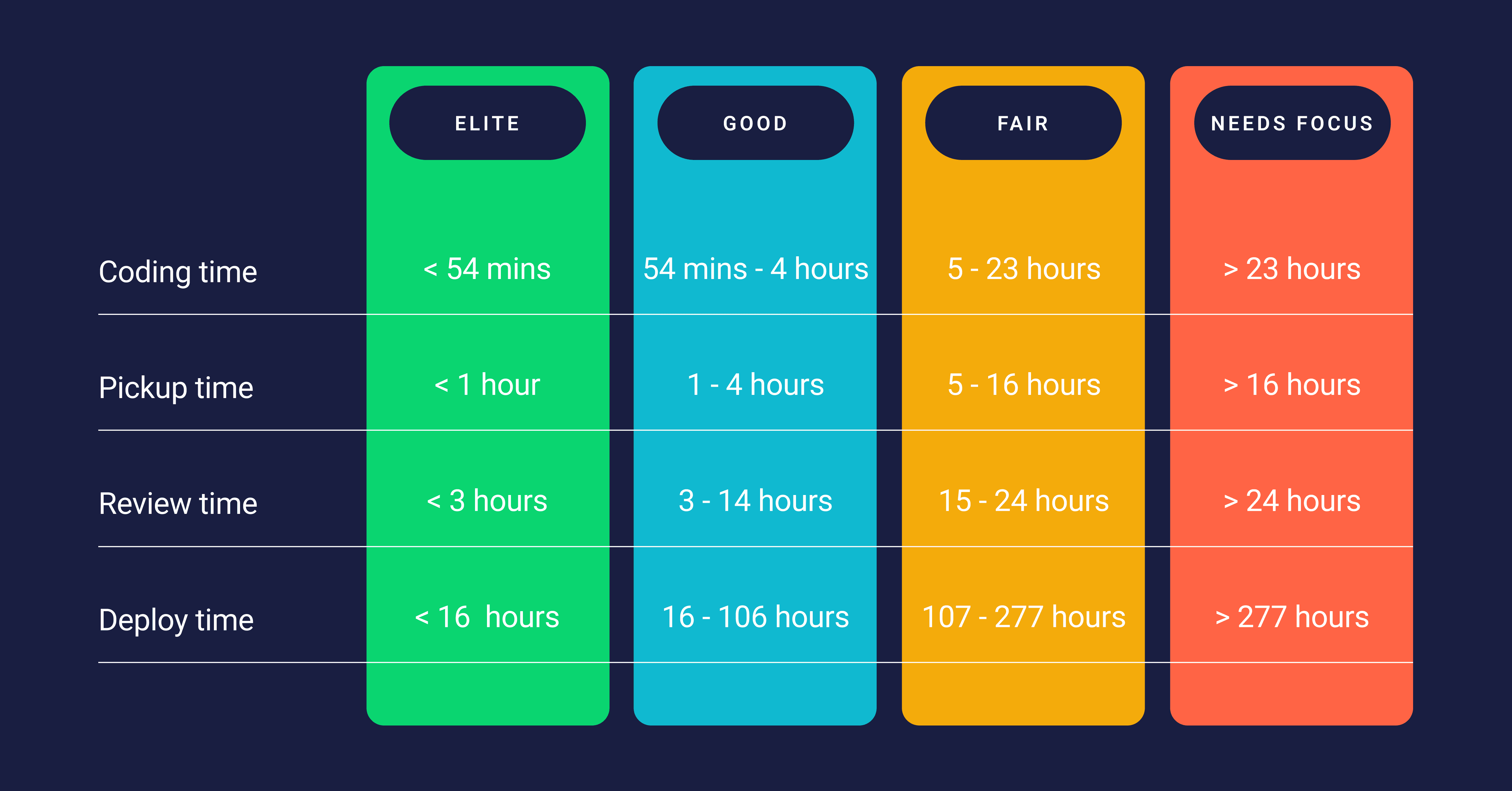
Source: LinearB's 2026 Software Engineering Benchmarks Report (8,109,244 pull requests, 4,813 teams, 163,820 active contributors).
Pickup time is the stage most disrupted by AI. When AI accelerates coding time, pull requests enter the review queue faster and in greater volume, and pickup time grows unless review capacity scales in parallel.
Download your free copy of the guide
Turning your diagnosis into a plan
A metric is only useful if you have a plan to act on what it shows. When cycle time slips, break it down into its four components and identify which stage is holding your system back. The most common bottleneck is code review: AI has sharply increased the rate of code being produced without giving the review process equivalent support, so pull requests pile up for humans to triage.
When cycle time data shows the review stage as the bottleneck, workflow automation is where the fix starts. AI code reviews catch security risks, bugs, performance issues, and spec mismatches before code merges, reducing the load on human reviewers for routine checks. gitStream, LinearB’s workflow automation engine, routes pull requests, enforces review policies, and automatically applies checks, letting review processes stay consistent and scalable as code volume increases.
Efficiency also underpins predictability. You cannot commit to a reliable delivery schedule on top of a delivery system that stalls in unpredictable places. Fixing the efficiency bottlenecks in your SDLC is what makes forecast accuracy possible.
What to do next: run your cycle time report for the past 30 days and identify which stage is furthest from the elite benchmark. That stage is where your first optimization effort should go.
Frequently asked questions
What is AI-driven SDLC efficiency?
AI-driven SDLC efficiency is the degree to which an engineering organization’s full software delivery lifecycle improves in speed and reliability as AI tools are adopted. It measures system outcomes, including throughput, cycle time, and change failure rate, not individual activity signals like adoption rates or token consumption.
Why do AI adoption rates fail executive scrutiny?
Adoption rates measure activity, not value. A developer who logs into an AI tool every morning is producing telemetry, not necessarily better software. Executives are asking whether your engineering organization became more efficient and more predictable, and adoption rates do not answer that question.
What does the APEX framework measure?
APEX measures four dimensions of engineering system health: AI leverage (whether AI investments translate into delivery improvement), Predictability (how reliably teams deliver on commitments), Efficiency (how well work flows through the delivery system), and Developer experience (whether the working environment contributes positively to productivity). Together, the four pillars describe whether the engineering system is improving overall, not just at the activity layer.
What are good cycle time benchmarks for software engineering teams?
According to LinearB’s analysis of 8,109,244 pull requests across 4,813 teams, elite-performing teams hit: coding time under 54 minutes, pickup time under 1 hour, review time under 3 hours, and deploy time under 16 hours. Teams with pickup time above 16 hours or deploy time above 277 hours are in the “needs focus” band and are likely absorbing significant productivity losses at those stages.
How do agentic AI pull requests affect code review capacity?
According to LinearB’s 2026 Software Engineering Benchmarks Report, agentic AI pull requests wait 5.25x longer before a reviewer picks them up compared to human-written ones. AI-assisted pull requests are also 2.6x larger on average. Both factors increase the load on human reviewers and push pickup time and review time higher, which is why those two cycle time stages are the most common bottlenecks in AI-augmented engineering teams.
Does AI increase deployment failures?
According to the 2025 DORA Report, teams that report individual productivity gains from AI are also reporting more deployment failures and longer recovery times. AI increases throughput at the code-creation stage while also increasing instability downstream. Tracking change failure rate alongside cycle time is how you confirm that speed gains are not coming at the cost of production reliability.
Written by Ori Keren, co-founder and CEO at LinearB.
