# AI Agents Will Take (Some of) Your Job. Here's How to Come Out Ahead | LinearB Blog

> AI agents are reshaping software development. Learn how to integrate AI into your workflows, automate repetitive tasks, and stay ahead. 

_This is a markdown rendering of a live HTML page on linearb.io, generated for AI/LLM consumption — it is not a markdown-only site. To get the full HTML page instead, request this URL with an explicit `Accept: text/html` header (no wildcard, no markdown preference)._

[Blog](https://linearb.io/blog)

/

AI Agents Will Take (Some of) Your Job. Here's How to Come Out Ahead

# AI Agents Will Take (Some of) Your Job. Here's How to Come Out Ahead

![Photo of Ben Lloyd Pearson](https://assets.linearb.io/image/upload/c_limit,w_2560/f_auto/q_auto/v1/blp_headshot_1_ee25d527aa?_a=BAVMn6ID0)

By [Ben Lloyd Pearson](https://linearb.io/blog/AI-agents-will-take-some-of-your-job#ben-lloyd-pearson)

|

March 4, 2025

![Blog_AI_Agents_Take_Job_325f7ac30f](https://assets.linearb.io/image/upload/c_limit,w_2560/f_auto/q_auto/v1/Blog_AI_Agents_Take_Job_325f7ac30f?_a=BAVMn6ID0)

Imagine a tool that spots a bug in your software, crafts the necessary fix, and commits the updated code to your repository, all before you’ve even noticed the issue. Does this sound far-fetched? It might not be. According to the 2024 [Stack Overflow developer survey](https://survey.stackoverflow.co/2024/), 76% of developers are using AI or plan to adopt it in 2025, signaling how quickly AI tools embed themselves in software delivery pipelines.
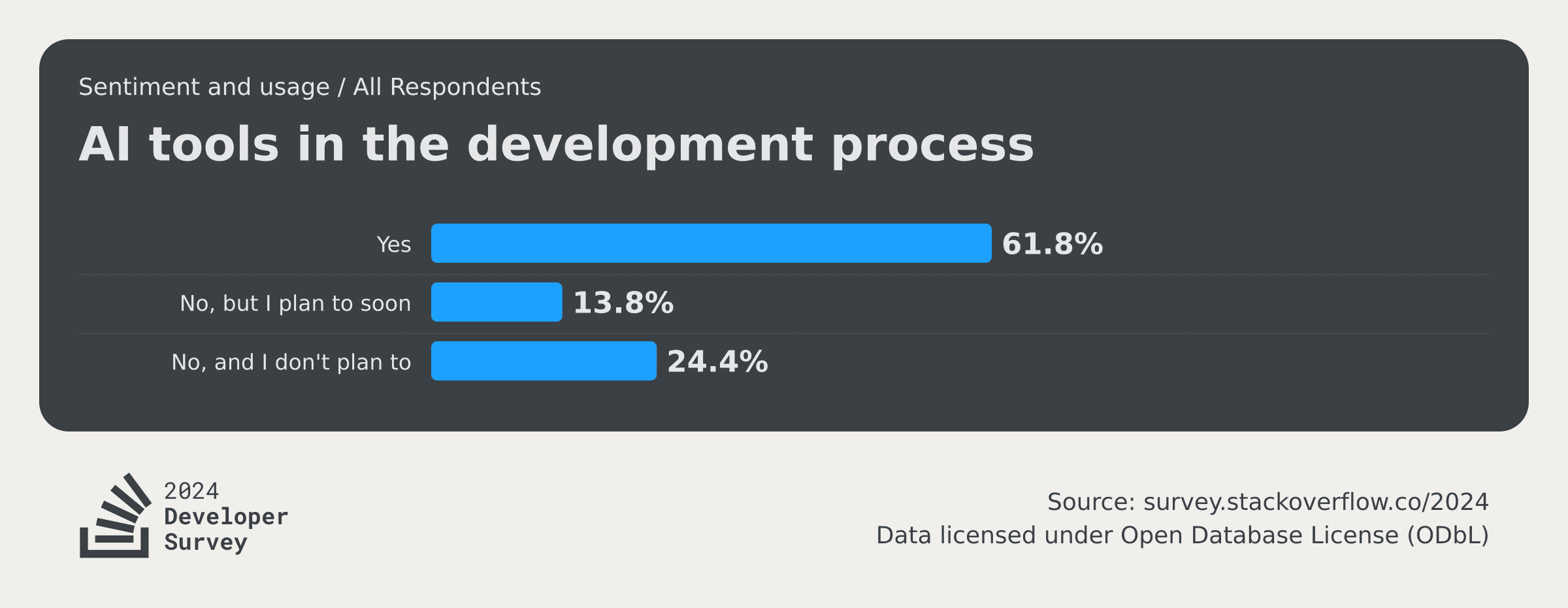
![Bar chart from the Stack Overflow 2024 Developer Survey showing AI tool adoption in the development process. Results indicate 61.8% of developers use AI tools, 13.8% plan to adopt them, and 24.4% do not intend to use AI for development tasks.](https://assets.linearb.io/image/upload/v1741121087/stackoverflow_dev_survey_2024_ai_sentiment_and_usage_ai_select_social_d0dcdf7f8f.png)

Yet, the first wave of generative AI adoption has yielded relatively modest gains, with about 10–20% productivity improvement in coding tasks, according to the latest research. That’s significant but not quite the overnight revolution many futurists predicted. The stark claims range from “developers will be obsolete next year” to “AI will help devs produce 50x the output.” The truth lies somewhere in between.

This article will separate hype from reality, show why developers are poised to feel AI's effects first, and offer a roadmap for integrating AI agents into your software delivery pipeline. 

The key insight: **AI won’t replace developers, but developers who effectively** [**orchestrate AI**](https://linearb.io/solutions/genai-orchestration) **will replace those who don’t.**

## **Why AI Agents Are the Next Frontier**

Generative AI has primarily lived in conversational interfaces like ChatGPT, where you type in prompts and get text-based responses. While useful, these systems mainly rely on human direction every step of the way.

[Agentic AI](https://linearb.io/blog/how-agentic-ai-will-disrupt-your-software-delivery-lifecycle) flips this script by adding autonomy. They’re action-oriented interfaces that can proactively analyze data, make decisions, and perform tasks, all with minimal manual oversight. Think of it as going beyond a chatbot to having a persistent assistant that observes your pipelines, tweaks the code, and opens pull requests, often before you ask it to.

Three traits make agentic AI services particularly powerful:

* **Proactive rather than reactive** \- AI agents identify and act on issues or opportunities.
* **Embedded in workflows** \- They integrate into CI/CD pipelines, code review processes, or logging systems, making them part of your daily toolkit.
* **Autonomy with guardrails**: You set the objectives, constraints, and acceptance criteria, and the agent handles the details.

Over time, as these systems improve, they’ll increasingly handle repetitive tokenizable tasks. Developers will then step in as overseers, strategists, and context-providers rather than laborers tied up in manual toil. 

## **Why Developers Are on the Front Lines**

Developers have become the earliest adopters of AI-driven automation for a few reasons. First, “scratching their own itch” drives developers to create AI agents that tackle mundane aspects of their day-to-day work. If you have the skills to automate repetitive tasks, like writing boilerplate code or [configuring CI/CD pipelines](https://linearb.io/blog/build-intelligent-ci-pipelines-gitstream-ci-orchestration), why not build a tool that frees up more time for creative problem-solving? This natural incentive propels rapid experimentation with AI.

Second, the open source culture so prevalent among developers amplifies this momentum. The community is known for embracing new technologies quickly and sharing their findings in real-time. As a result, open source frameworks, libraries, and AI models are emerging remarkably, enabling countless developers to refine, adapt, and ultimately adopt these tools in their projects. This collaborative environment accelerates innovation and spreads best practices globally.

Finally, there is the tokenization of knowledge work: an ongoing shift where tasks once requiring human cognition, such as debugging, refactoring, or triaging bugs, are becoming increasingly automated. Because the ecosystem of code automation already exists, developers are naturally the first to experience the impact. They can feel the disruption most acutely as repetitive tasks fall under the purview of AI agents that can reliably replicate or augment human effort.
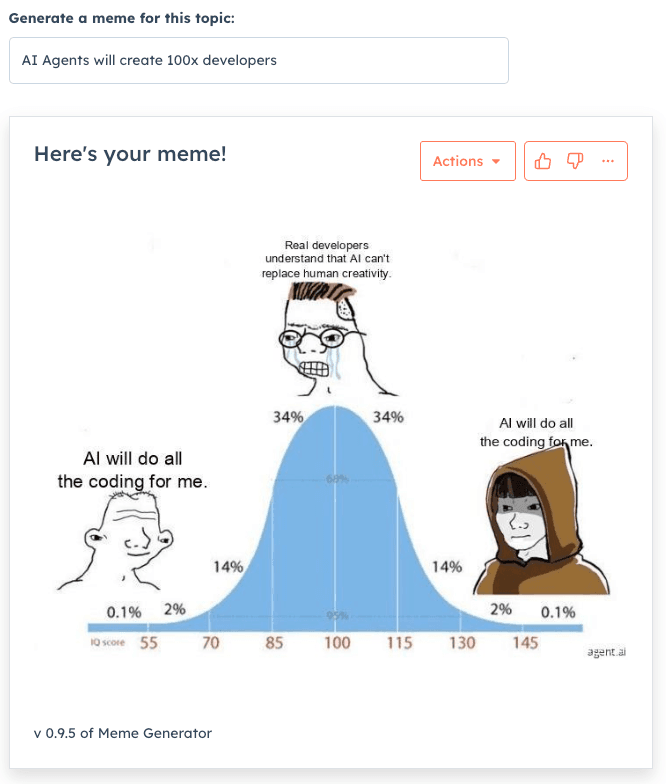
![Meme illustrating perceptions of AI coding capabilities, using the intelligence bell curve format. The left and right extremes depict individuals believing AI will handle all coding, while the center acknowledges AI's limitations in replacing human creativity. Satirical take on AI's impact on software development.](https://assets.linearb.io/image/upload/v1741121087/AI_Agents_will_write_all_my_code_98f3d5579a.png)

AI will do all the memes for me. [Source](https://agent.ai/profile/9kuy7lwvuud9yyzl).

## **4\. The Real, Overblown Threat**

Despite rapid progress, it’s important to separate real from overblown threats.

The real threat is the incremental takeover of routine tasks. Activities like writing boilerplate code, analyzing logs for known patterns, or generating basic documentation will shift to AI agents. For some developers, that’s a big part of their job.

The overblown threat is the idea that entire development teams will be obsolete next year. So far, organizations report roughly 10–20% productivity boosts from first-generation AI coding assistants. We’re nowhere near a scenario where AI fully replaces the higher-level design, creative thinking, and decision-making that developers do.

In short, the doomsday predictions often miss the nuance: AI agents are expanding developers’ capacity to innovate by offloading routine tasks, not making them extinct.

![Illustration depicting the six stages of AI adoption among software developers, from skepticism to full integration. The stages include doubt, experimentation, alarm, uncertainty, engagement, and realization of AI's role in development. Stick figure characters on a divided landscape visually represent the transition through these phases.](https://assets.linearb.io/image/upload/v1741121087/six_stages_of_dev_AI_040d9e58e1.png)

We’re all in this picture. [Source](https://ghuntley.com/ngmi/).

## **Winning Strategies for Adopting AI Agents effectively**

If AI is inevitably taking over repetitive work, how do you ensure your team, skills, and organization remain relevant? Focus on delegating the right tasks to AI while retaining oversight. Here are six strategies for adopting AI agents effectively, with a breakdown of each agent’s role vs. the developer’s roles.

### **Knowledge & Skills Development**

**Agent’s Role**

* **Distribute internal knowledge**: Tap into your organization’s wikis, internal repositories, and FAQs.
* **Rapidly onboard developers**: Provide real-time context on codebases, architecture, or processes to junior and senior devs entering new domains.

**The Developer's Role**

* **Validate & refine**: Double-check the AI’s answers and provide feedback when they are off-base to improve future responses.
* **Foster continuous learning:** identify knowledge gaps in your organization and improve documentation or training materials.

### **Automated Code Reviews**

**Agent’s Role**

* **First-line defense**: Catch syntax errors, style issues, and straightforward logic flaws before a human reviewer sees the code.
* **Review guide**: Help developers understand how to resolve issues that surface from automated services to stay aligned with project conventions, security guidelines, and best practices.

**The Developer's Role**

* **Focus on intent and context**: Instead of nitpicking format or minor errors, review why the team made design choices and provide higher-level feedback.
* **Fine-tune rules**: Update or refine your AI agent’s guidelines so it continues learning what your team values in [code reviews](https://linearb.io/blog/how-to-do-code-reviews-better).

### **Intelligent Log Analysis**

**Agent’s Role**

* **Detect patterns and anomalies**: Sift through mountains of logs to identify unusual spikes, trends, or error codes that might signal deeper issues.
* **Recommend actions**: Surface potential fixes or escalations (e.g., “This anomaly corresponds to a known memory leak issue. Patch recommended.”).

**The Developer's Role**

* **Investigate recommendations**: Validate whether the suggestions are correct in real-world conditions and refine the agent’s understanding.
* **Prioritize fixes**: Use domain knowledge to decide whether a flagged issue is genuinely urgent or can wait.

### **Automated Testing & QA**

**Agent’s Role**

* **Coverage checks**: Continuously monitor repositories for gaps in test coverage, pointing out new or changing code that lacks adequate tests.
* **Edge-case detective**: Suggest potential corner cases that may need specialized testing.

**The Developer's Role**

* **Provide context for why and how**: Explain business logic or domain constraints so the agent learns the nature of acceptable vs. unacceptable outcomes.
* **Accept or refine suggestions**: Merge recommended changes if they match your project’s needs or correct them if the AI misunderstood something.

### **Bug Triage & Prioritization**

**Agent’s Role**

* **Monitor bug reports and error logs:** Automatically categorize, prioritize, and assign issues based on historical resolution patterns and severity indicators.
* **Generate next-step suggestions**: Offer possible fixes or relevant documentation references.

**The Developer's Role**

* **Validate final priorities**: Confirm that the agent’s triaging aligns with real-world impact, team capacity, and strategic goals.
* **Offer feedback loops**: Provide the agent with updated priorities or reclassifications to sharpen its future recommendations.

### **Documentation Generation & Maintenance**

**Agent’s Role**

* **Continuous doc updates**: Add or revise documentation, comments, commit messages, and usage examples whenever code changes.
* **Sync what and how**: Ensure internal and external docs reflect current platform realities.

**The Developer's Role**

* **Clarify the why**: Share business context, project history, and rationale for design decisions, which the agent needs to produce coherent, meaningful documentation.
* **Periodically review**: Spot-check the generated docs to ensure accuracy, completeness, and alignment with project goals.

## **The Future Is AI-Orchestrated Software Development**

AI agents are poised to reshape how software is built by augmenting and automating the low-level tasks that distract from high-value work. In the near term, generative AI can deliver notable, though not yet earth-shattering, productivity boosts. Over time, as these agentic systems become more sophisticated, developers will shift from doing routine tasks to orchestrating them, focusing on strategy, architecture, and creative problem-solving.

Approach AI adoption with a clear strategy. Identify the repetitive tasks that are genuinely tokenizable, delegate them to AI, and layer in human oversight for context. You’ll free your team to innovate, adapt, and push boundaries in ways that purely manual processes can’t match.
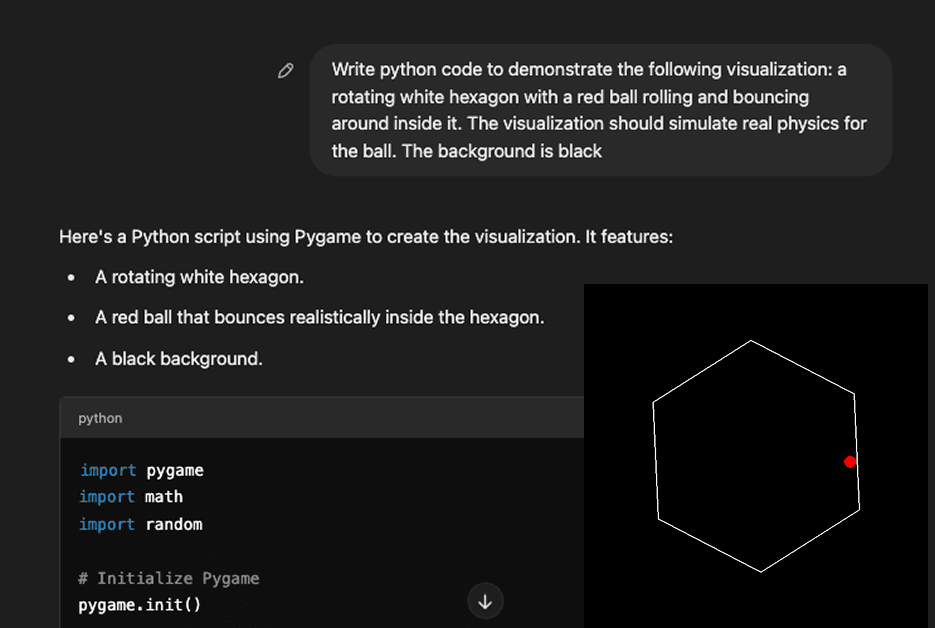
![Screenshot of a coding request and Python script using Pygame to visualize a rotating white hexagon with a bouncing red ball on a black background. Demonstrates AI-assisted code generation for physics-based simulations in Python.](https://assets.linearb.io/image/upload/v1741121085/Why_is_this_a_benchmark_43d8a8cca0.png)

Who decided to make this the benchmark to measure AI success?

If you want to embrace this agentic future, LinearB can help you navigate the transformation. Our [developer productivity](https://linearb.io/blog/developer-productivity) experts have the experience and tools to make your transition smooth and effective. [Reach out today](https://linearb.io/book-a-demo) to discover how AI-driven workflows can supercharge your engineering organization’s impact.

## Improve developer productivity with LinearB

Find us on

[](https://www.linkedin.com/company/linearb)
[](https://devinterrupted.substack.com/)

![blp_headshot_1_ee25d527aa](https://assets.linearb.io/image/upload/c_limit,w_2560/f_auto/q_auto/v1/blp_headshot_1_ee25d527aa?_a=BAVMn6ID0)

## Ben Lloyd Pearson

Ben hosts Dev Interrupted, a podcast and newsletter for engineering leaders, and is Director of DevEx Strategy at LinearB. Ben has spent the last decade working in platform engineering and developer advocacy to help teams improve workflows, foster internal and external communities, and deliver better developer experiences.

### Connect with

[](https://www.linkedin.com/in/benlloydpearson)
[](https://substack.com/@benlloydpearson)

## Your next read

[![Cover image for Slack turns channels into the context engine for agentic AI](https://assets.linearb.io/image/upload/c_limit,w_2560/f_auto/q_auto/v1/Blog_Post_Name_2400x1256_077524ba8b?_a=BAVMn6ID0)](https://linearb.io/blog/slack-jaime-delanghe-mcp-agent-context-channels)

Workflow

[Slack turns channels into the context engine for agentic AI](https://linearb.io/blog/slack-jaime-delanghe-mcp-agent-context-channels)

Slack Chief Product Officer Jaime DeLanghe breaks down how channels serve as the foundational context layer for human-agent collaboration. Learn why Slack is...

[![Cover image for Code generation is faster than ever, but shipping value isn't](https://assets.linearb.io/image/upload/c_limit,w_2560/f_auto/q_auto/v1/Blog_AI_code_review_bottleneck_2400x1256_d73333ea46?_a=BAVMn6ID0)](https://linearb.io/blog/code-generation-faster-shipping-isnt)

Workflow

[Code generation is faster than ever, but shipping value isn't](https://linearb.io/blog/code-generation-faster-shipping-isnt)

Your team writes more code than ever, but less reaches production. AI moved the bottleneck to code review. Here's how to measure it and unblock your pipeline.&n...

[![Cover image for AI as a value multiplier: a human-centric approach to engineering leadership](https://assets.linearb.io/image/upload/c_limit,w_2560/f_auto/q_auto/v1/Blog_Servant_Leadership_2400x1256_0cfd4e2a0c?_a=BAVMn6ID0)](https://linearb.io/blog/ai-as-value-multiplier-human-centric-leadership)

Workflow

[AI as a value multiplier: a human-centric approach to engineering leadership](https://linearb.io/blog/ai-as-value-multiplier-human-centric-leadership)

Super.com's Matt Culver explains why AI should be used as a value multiplier, not a cost-cutter, advocating for a human-centric approach to engineering...

## Structured data

_Machine-readable metadata (JSON-LD) embedded in the page for search/AI context — not content rendered on the page itself._

```json
{
  "@context": "https://schema.org",
  "@type": "Organization",
  "name": "LinearB",
  "url": "https://linearb.io",
  "logo": "https://assets.linearb.io/image/upload/v1715628027/logo-mark-lg.svg",
  "description": "LinearB is the engineering productivity platform that helps engineering leaders prove AI is improving throughput without sacrificing delivery confidence, flow efficiency, or developer experience.",
  "sameAs": [
    "https://www.linkedin.com/company/linearb"
  ],
  "award": [
    {
      "@type": "Award",
      "name": "LinearB is a Leader in the 2026 Gartner® Magic Quadrant™ for Developer Productivity Insight Platforms",
      "dateAwarded": "2026",
      "awardedBy": {
        "@type": "Organization",
        "name": "Gartner®"
      }
    },
    {
      "@type": "Award",
      "name": "Great Place to Work Certification",
      "dateAwarded": "2025-2027",
      "awardedBy": {
        "@type": "Organization",
        "name": "Great Place to Work"
      }
    },
    {
      "@type": "Award",
      "name": "America's Best Startup Employers 2025",
      "dateAwarded": "2025",
      "awardedBy": {
        "@type": "Organization",
        "name": "Forbes Magazine"
      }
    }
  ],
  "hasCertification": [
    {
      "@type": "Certification",
      "name": "SOC 1 Type 2"
    },
    {
      "@type": "Certification",
      "name": "SOC 2 Type 2"
    },
    {
      "@type": "Certification",
      "name": "GDPR Compliance certification"
    },
    {
      "@type": "Certification",
      "name": "ISO 27001"
    }
  ]
}
```

```json
{
  "@context": "https://schema.org",
  "@type": "Article",
  "headline": "AI Agents Will Take (Some of) Your Job. Here's How to Come Out Ahead",
  "url": "https://linearb.io/blog/AI-agents-will-take-some-of-your-job",
  "author": {
    "@type": "Person",
    "name": "Ben Lloyd Pearson"
  },
  "datePublished": "2025-03-04T08:00:00.000Z",
  "dateModified": "2025-03-04T08:00:00.000Z",
  "image": "https://assets.linearb.io/image/upload/v1743110876/Blog_AI_Agents_Take_Job_325f7ac30f.png",
  "publisher": {
    "@type": "Organization",
    "name": "LinearB",
    "logo": "https://assets.linearb.io/image/upload/v1777485755/linearb-logo-2026.png"
  },
  "description": "AI agents are reshaping software development. Learn how to integrate AI into your workflows, automate repetitive tasks, and stay ahead. "
}
```

## More on linearb.io

### Top navigation

- [Book a Demo](https://linearb.io/book-a-demo)
- [AI Code Reviews — Catch security risks, bugs, and spec mismatches](https://linearb.io/platform/ai-code-reviews)
- [AI & Productivity Insights — See how AI tools affect cycle time and delivery speed](https://linearb.io/platform/ai-developer-productivity-insights)
- [Measure AI Impact — Track AI adoption and tie it to delivery outcomes](https://linearb.io/use-case/measure-ai-impact)
- [MCP Server — Chat with your data to spot patterns and boost output](https://linearb.io/platform/mcp-server)
- [Resource Allocation — Cost initiatives and shape your investment strategy](https://linearb.io/platform/resource-allocation)
- [Cost Capitalization — Capitalize engineering costs with audit-ready reports](https://linearb.io/platform/cost-capitalization)
- [Dev Team Management — Set targets and tie throughput to business outcomes](https://linearb.io/platform/goals-and-reporting)
- [DevOps Workflow Automation — Policy-based PR routing, approvals, and tests](https://linearb.io/platform/ai-workflow-governance)
- [AI Powered Support — Unify AI and human code delivery in one clear view](https://linearb.io/use-case/ai-powered-support)
- [Optimization — Surface friction with feedback and MCP insights](https://linearb.io/platform/developer-experience)
- [Reporting — Spot what's working and what needs attention](https://linearb.io/use-case/measuring-developer-experience)
- [Surveys — Turn developer feedback into actionable signals](https://linearb.io/platform/developer-surveys)
- [Platform overview](https://linearb.io/platform/overview)
- [Register now](https://linearb.io/event/engineering-productivity-gap)
- [Customers](https://linearb.io/customers)
- [Pricing](https://linearb.io/pricing)
- [Why choose LinearB — Explore your data. Measure performance. Act to improve it.](https://linearb.io/why-linearb)
- [APEX framework — The operating model for AI-era engineering teams](https://linearb.io/resources/apex-framework)
- [Anti-FAQ — The questions other vendors won't answer](https://linearb.io/why-linearb/anti-faq)
- [Security — Enterprise-grade compliance and zero code access](https://linearb.io/security)
- [Build vs. buy — The hidden cost of building it yourself](https://linearb.io/resources/build-vs-buy)
- [Dev Interrupted Podcast — Conversations with engineering leaders](https://linearb.io/dev-interrupted/podcasts)
- [Reports & Guides — Deep dives on productivity and delivery](https://linearb.io/resources)
- [Webinars — Expert sessions on productivity and AI](https://linearb.io/resources?category=workshops)
- [Metrics Benchmarks — See how your engineering org stacks up](https://linearb.io/resources/software-engineering-benchmarks-report)
- [Blog — Product updates and practical insights](https://linearb.io/blog)
- [Help Center — Documentation, setup, and support](https://linearb.helpdocs.io)
- [API Docs](https://docs.linearb.io/api-overview)
- [Status](https://www.linearbstatus.com/)
- [Integrations](https://linearb.io/integrations)
- [LinearB is a Leader in the 2026 Gartner® Magic Quadrant™ for Developer Productivity Insight Platforms](https://linearb.io/resources/gartner-magic-quadrant-dpi-platforms-2026)
- [Sign in](https://app.linearb.io/login)
- [Enterprise](https://linearb.io/solutions/enterprise)
- [Contact](https://linearb.io/contact-us)
- [About us](https://linearb.io/about-us)
- [Careers](https://linearb.io/careers)
- [Service agreement](https://linearb.io/services-agreement)
- [Privacy policy](https://linearb.io/privacy-policy)
- [DPA](https://linearb.io/data-processing-agreement)
- [Security FAQ](https://linearb.io/security-faq)
- [Substack](https://devinterrupted.substack.com/)

### Footer

_Additional links from the site footer, not repeated from the top navigation above._

- [GitHub](https://github.com/linear-b)
- [LinkedIn](https://www.linkedin.com/company/linearb)
- [Twitter](https://twitter.com/LinearB_Inc)