

Your PR volume is up, and AI wrote more of the code arriving in review. Your delivery metrics show that shift as it happens, because they come from data already moving through your tools. How your developers are experiencing it doesn't show up in any of them, and the only way to find out is to ask.
So we've made asking easier. Surveys now arrive as a Slack message developers can answer without logging in, and you can write your own questions, including open-text and multiple-choice ones. The updates are available today to all LinearB customers with Slack connected, under Productivity > Surveys. If your organization uses Microsoft Teams, reach out to your CSM to learn more.
Write your own topics and questions in LinearB Surveys
Your company already runs an employee engagement survey. People sends it once or twice a year to everyone from sales to legal, and the results reach you weeks later. You didn't write the questions, you can't ask a follow-up, and the results arrive grouped by department, so you can't see how any one engineering team answered.
The standard topics in LinearB Surveys assume the person answering builds software, and each rating comes with a written prompt so a low score arrives with its reason. The AI-assisted development topic asks:
- "I feel confident using AI tools without compromising quality or security." What concerns, if any, do you have about AI's role in your work?
- "AI-generated code is reliable and useful, whether suggested or autonomously written." How do AI-generated code suggestions accelerate or disrupt your workflow?
Code quality and maintainability, and productivity and workflow, cover the work around it:
- "We maintain high quality standards even when working under tight deadlines." Where do we succeed or struggle in balancing speed and quality?
- "The code review process fits well into our development workflow without causing bottlenecks." What aspects of the review process work well or could be improved?
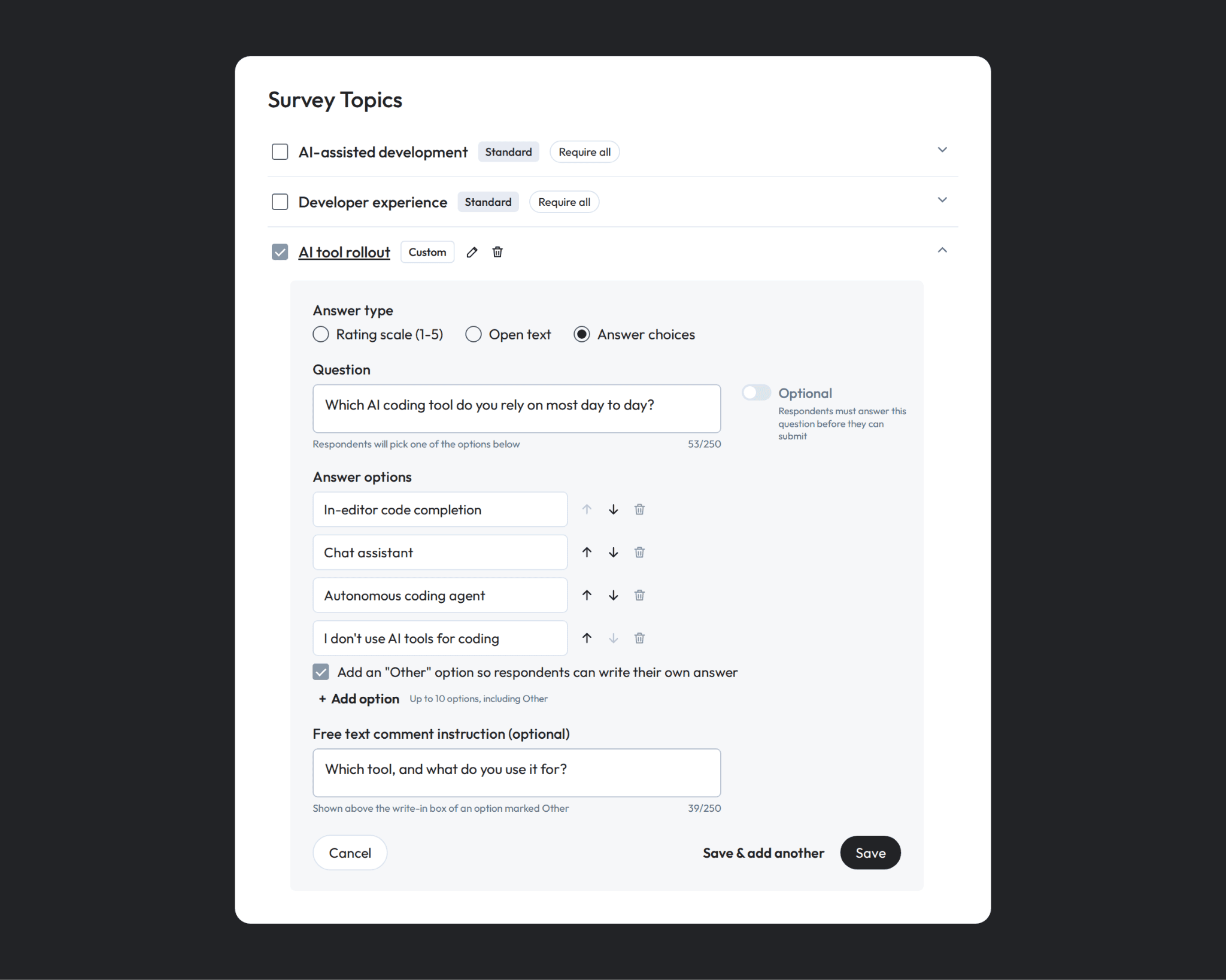
With this update, you can also write your own topics and questions for anything specific to your organization, like a tool rollout, a reorg, or a policy nobody follows. Custom questions take your own answer choices or open text, and you can mix them with the standard topics however you need, so a quarterly org-wide survey and a pulse on one team can cover different ground.
Slack distribution brings in more responses
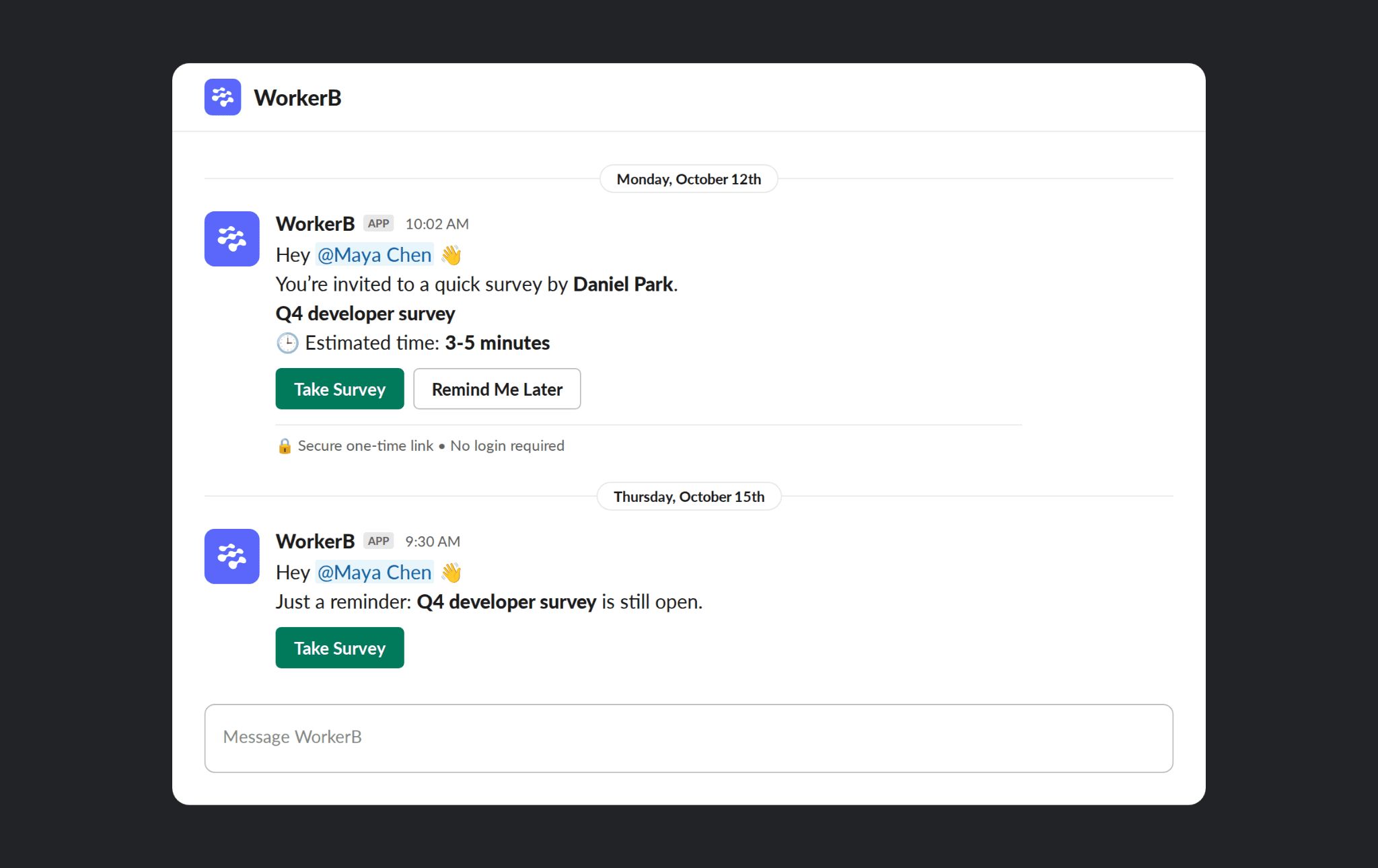
LinearB now sends surveys through Slack to whoever you choose, whether that's the whole engineering organization, a specific team, or named individuals. Each person gets a direct message with a personal link, so they can answer without logging in. While a survey is running, you can send a reminder from its menu, and LinearB messages only the people who haven't finished. Respondents can also save their progress and come back to a longer survey later, so you hear back from more of each team.
We recommend an org-wide survey each quarter, with pulse surveys in between for faster-moving organizations. You can duplicate a survey to re-run it, and each round becomes the baseline for the next. When you send a pulse to one team before a change and again afterwards, you find out whether the change helped.
Team scores show who's struggling, and which teams have worked it out
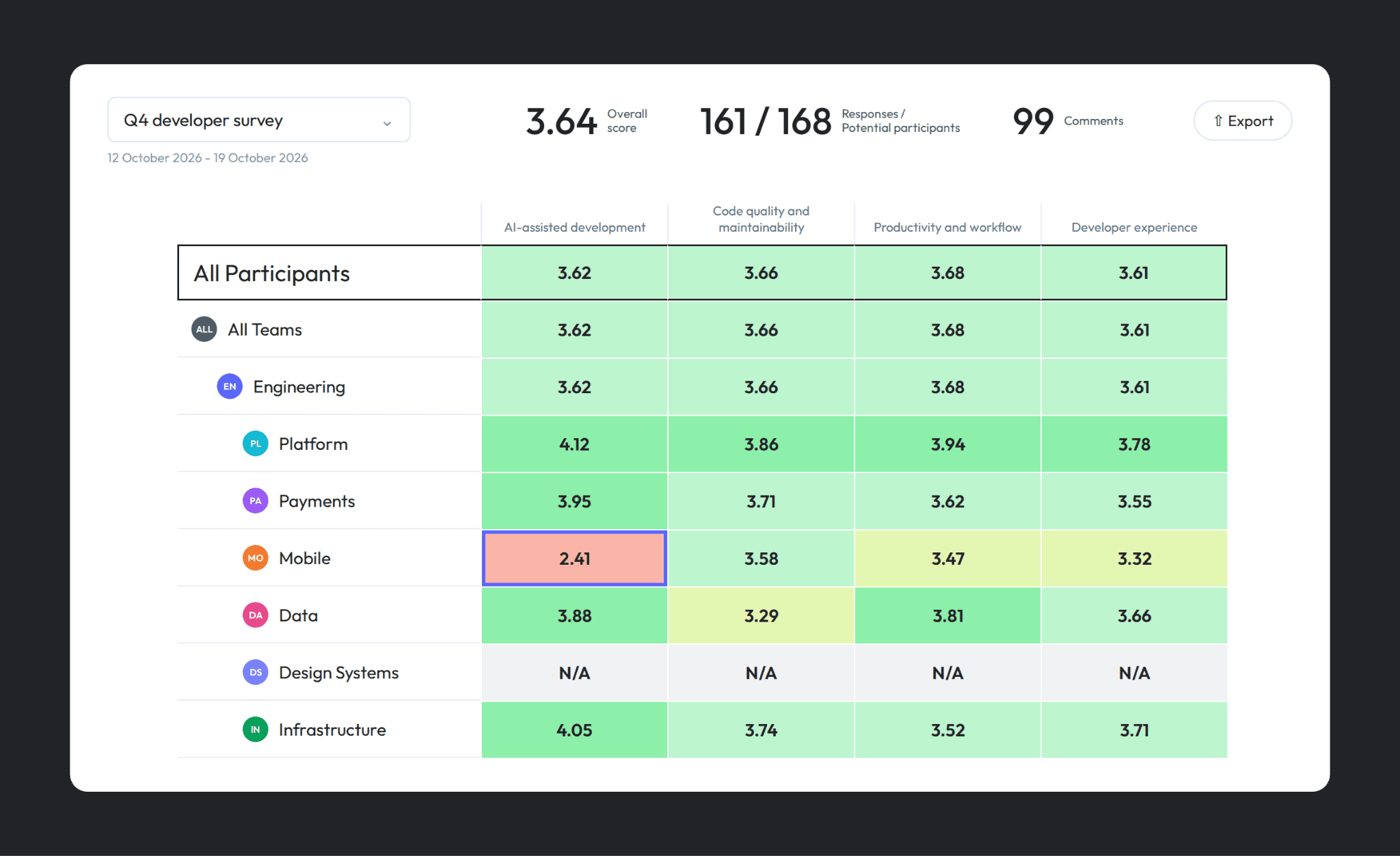
LinearB opens the results on one score for your organization, with response and comment counts beside it, and scores every team against every topic underneath. Reading one team across every topic shows where that team is struggling. Reading one topic across every team shows whether a low score is local or systemic, since friction every team reports is yours to fix, while one team scoring low is a conversation with that team.
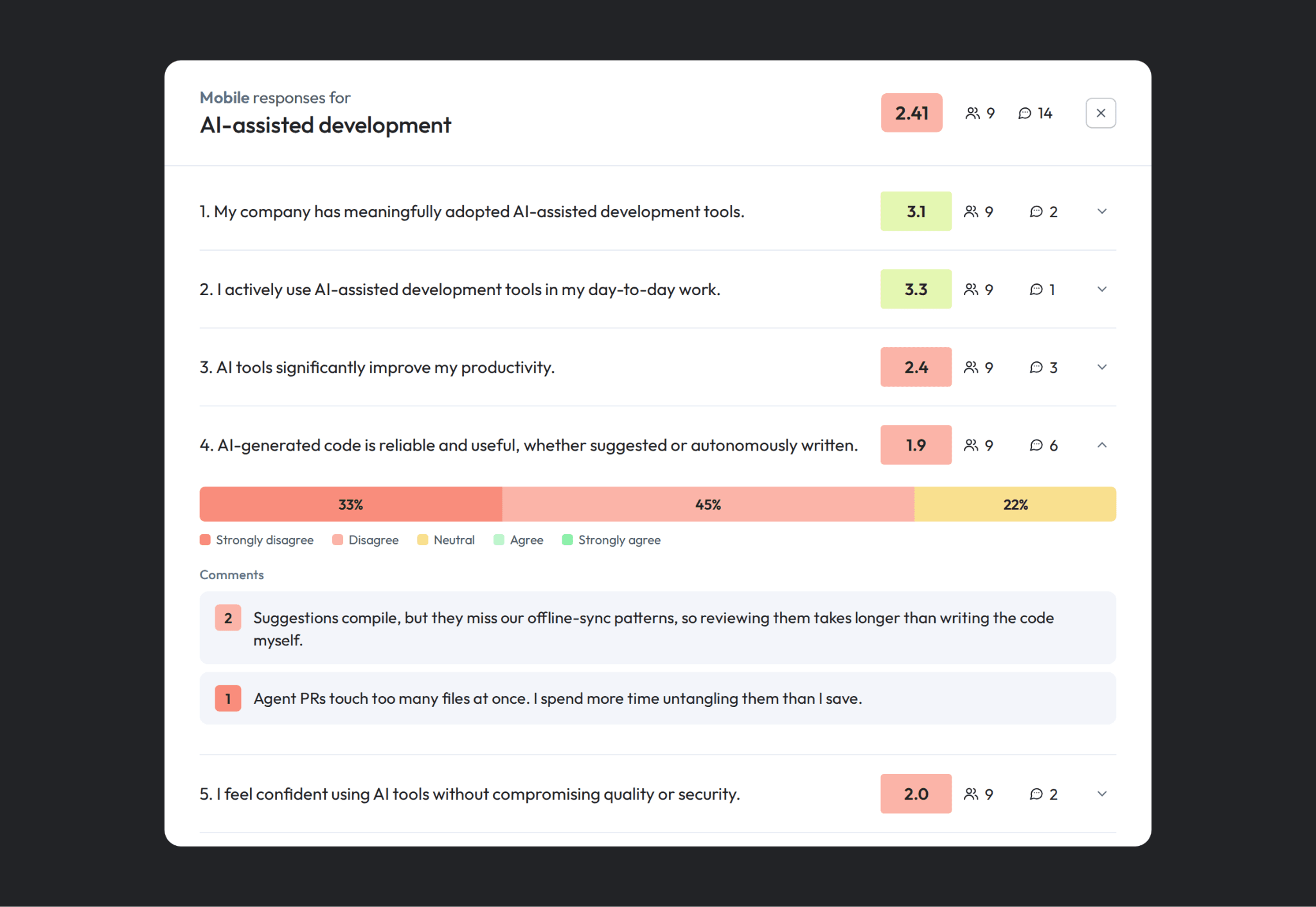
When you open the cell where a team meets a topic, LinearB breaks that team's answers down question by question, then down to the spread of responses and what people wrote. Comments stay hidden for any question with fewer than five responses, because a team of three has no anonymity otherwise. You can export the results for a leadership review or a retro.
The same drill-down works on the team scoring well where others struggle, and their comments tell you what they're doing differently on your own codebase.
When a topic flags review load or shaky confidence in what reaches production, you can act on it this week. gitStream rebalances review assignment and merge policy, and AI code reviews catch issues before they merge. Other findings are directional, like how sustainable the pace feels or how clearly a team sees where the work is headed. Those need a conversation, and the survey tells you which one to have, and with which team.
Get started
Your delivery metrics show what your teams shipped, and LinearB Surveys shows how the people who shipped it are holding up. Reading the two side by side for a team tells you whether a slowdown comes with a team that's struggling, or one that's fine and blocked by something else. We're working on bringing them closer together in LinearB, so expect more here.
Start with the one topic you're least sure about, send it to a team you know well, and see whether the answers match your read. Read the Surveys docs to set up your first survey, or book a demo if you're new to LinearB.