Your software factory needs a context layer

Summary
- The context layer: the connective tissue that unifies source control, issues, CI, deploys, and AI tool signals into one traceable record.
- AI adoption is a signal, not a result. Elite orgs in LinearB’s benchmark population, 54% of pull requests use AI assistance, but proves nothing about delivery.
- Effective PR yield, meaning pull requests merged minus rework, matters more than raw volume. Agentic pull requests merge at 37% in less mature organizations.
- Cost per effective PR, calculated as (people cost + AI spend) ÷ (PRs opened × effective yield), is the one metric that shows whether AI spend reaches delivery.
- Close the loop by instrumenting one feedback loop at a time and judging it against the baseline you captured on the way in.
You are building a software factory, where AI agents and developers produce code at volume across a repeatable pipeline, but you can't yet answer the question your board is asking: is it working? The answer lives between your tools, not inside any one of them. What merged, what it cost, and what you promised each sit in a different system, so no single dashboard tells you whether your AI adoption is meeting the target.
A context layer closes that gap. It unifies the signals from your software development lifecycle, including source control, issues, CI, deploys, and AI coding tools, into one record you can trace from spec to ship. With that record you can prove AI is improving throughput instead of only generating more of it. This guide draws on LinearB’s benchmark data to show how to instrument a software factory, why cost per effective PR is the metric that proves the value, and the playbooks you can run this week.
What is a software factory?
A software factory is an operating model, and most engineering orgs are already running parts of it whether or not they use the term. Agents open pull requests, review code, and touch the delivery pipeline more than ever before. What is hard to get is org-wide, trended evidence that the factory is delivering more value, rather than only generating more code.
Even the most advanced teams have headroom. Among elite organizations in LinearB’s benchmark population, the top performance band, 54% of pull requests use AI assistance, 13% of developers use AI on three-quarters or more of their working days, and 4.7% of pull requests are opened autonomously by agents. The takeaway is that adoption is one signal among many. By itself, it proves nothing about the SDLC or the value of AI.
Building toward that headroom without a record of where you started leaves you exposed to a failure mode called tokenmaxxing, where the only incentive is more spending. That hides inefficiency and blocks optimization, which is why token-count scoreboards are falling out of favor as a measure of success. For the alternative, see LinearB’s take on life beyond tokenmaxxing.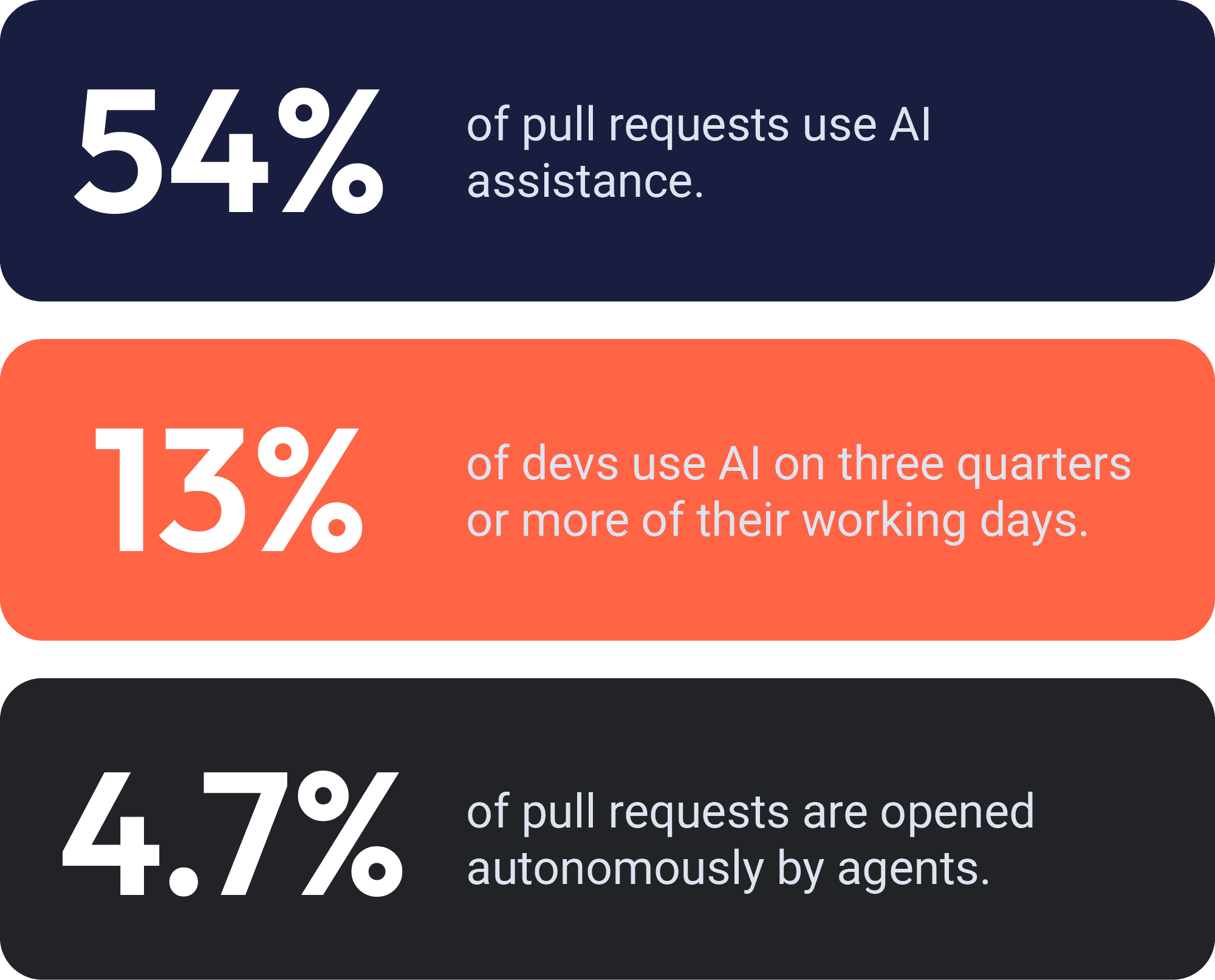
What to do next: capture a baseline for AI adoption and delivery before you scale agent volume, so every later gain has a starting line to measure against.
The damage arrives weeks after the tests go green
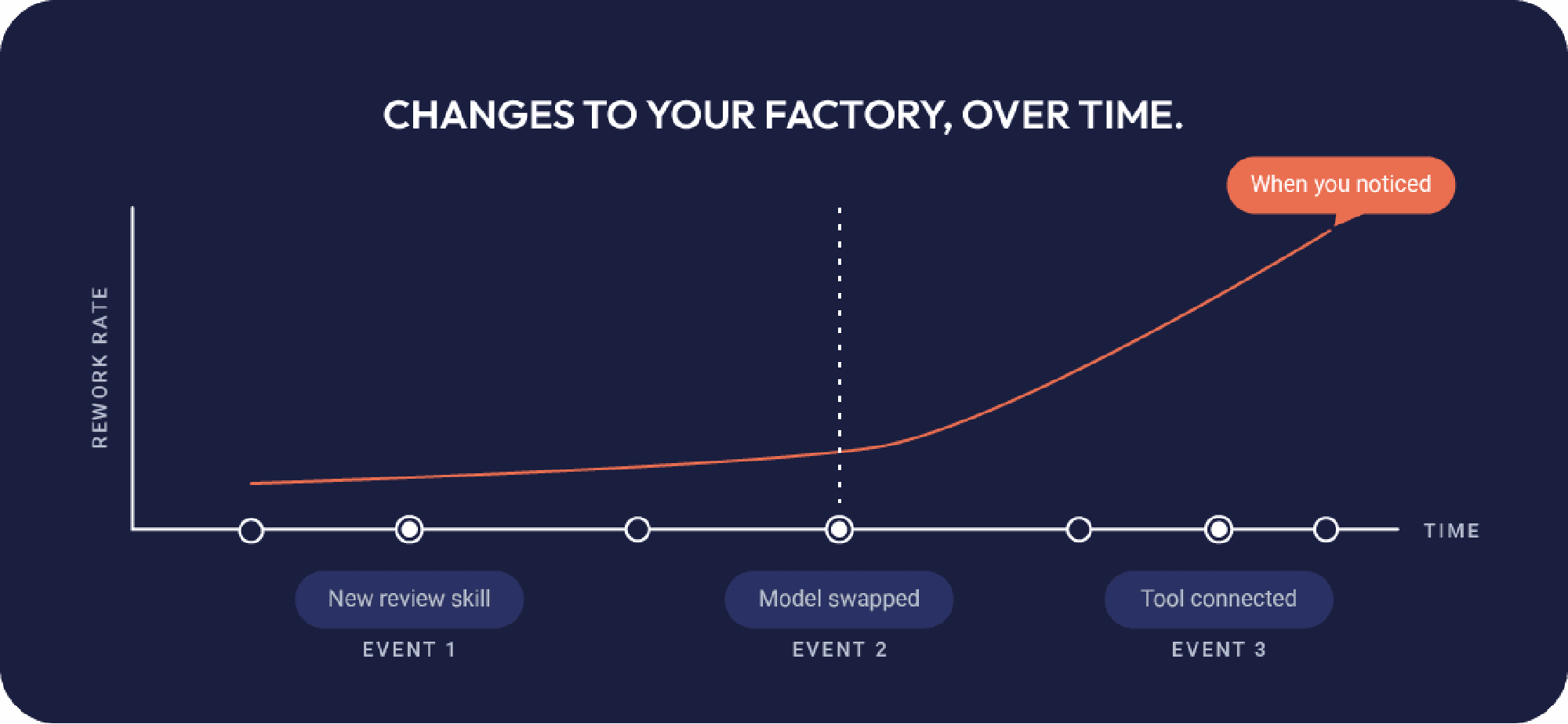
Tests pass, volume climbs, and rot surfaces later in code no one can understand or safely change. By the time it reads as a slipped roadmap or a red status page, the cheap window to fix it has closed. Code quality degrades over time in ways tests don’t catch, and a well-factored codebase costs less to extend, in tokens as well as time, as it ages.
Independent research backs the pattern. In SlopCodeBench, published by researchers at the University of Wisconsin-Madison, Washington State University, and MIT, agent-generated code showed structural erosion in 77% of trajectories and rising verbosity in 75.5%, degrading faster than human-written repositories across long-horizon tasks. No modern benchmark fully tests how a model affects a codebase over time, so that viewport is one input, not the whole answer.
The answer comes from measuring the rate of agentic PRs and their rework rate over time, which gives you an effective PR yield: pull requests opened minus the ones that get reworked. Connecting your source control to a context layer lets you instrument and study that yield, then act on it with tools like AI code review to catch bad code smells early, prioritize small PRs, and free human attention for the judgment calls.
What to do next: track effective PR yield (PRs merged minus rework) as a trend, not a snapshot, so quality erosion shows up while the fix is still cheap.
Download your free copy of the guide
AI moves the bottleneck downstream instead of removing it
When AI speeds up coding, the bottleneck moves instead of disappearing, and it lands on whatever comes next, which was sized for the old rate. A single cycle time number can sit flat while a real gain happens underneath it, as coding shrinks, something downstream grows, and the total barely moves. Decompose the stages and you see both the coding win and the queue it ran into.
The new constraint isn’t always technical. At Kraken, engineering lead Nik Sudan came in expecting review slowdown to trace to code size and complexity. Using LinearB as the context layer to find the real bottleneck, he learned that size and complexity accounted for 5% to 10% of the slowdown, while 70% to 80% came from time zone differences, team silos, and reviewer availability. Kraken cut review time by more than 50% in four months and now benchmarks each development group against its own baseline instead of a leaderboard.
Amritansh Raghav, Head of Engineering at Asana, describes the same movement: as code generation accelerates, engineers feel more pain across verification, testing, and getting a PR ready to ship, then further downstream in deployment and ops. The work doesn’t disappear, it moves to parts of the pipeline that weren’t built to absorb it.
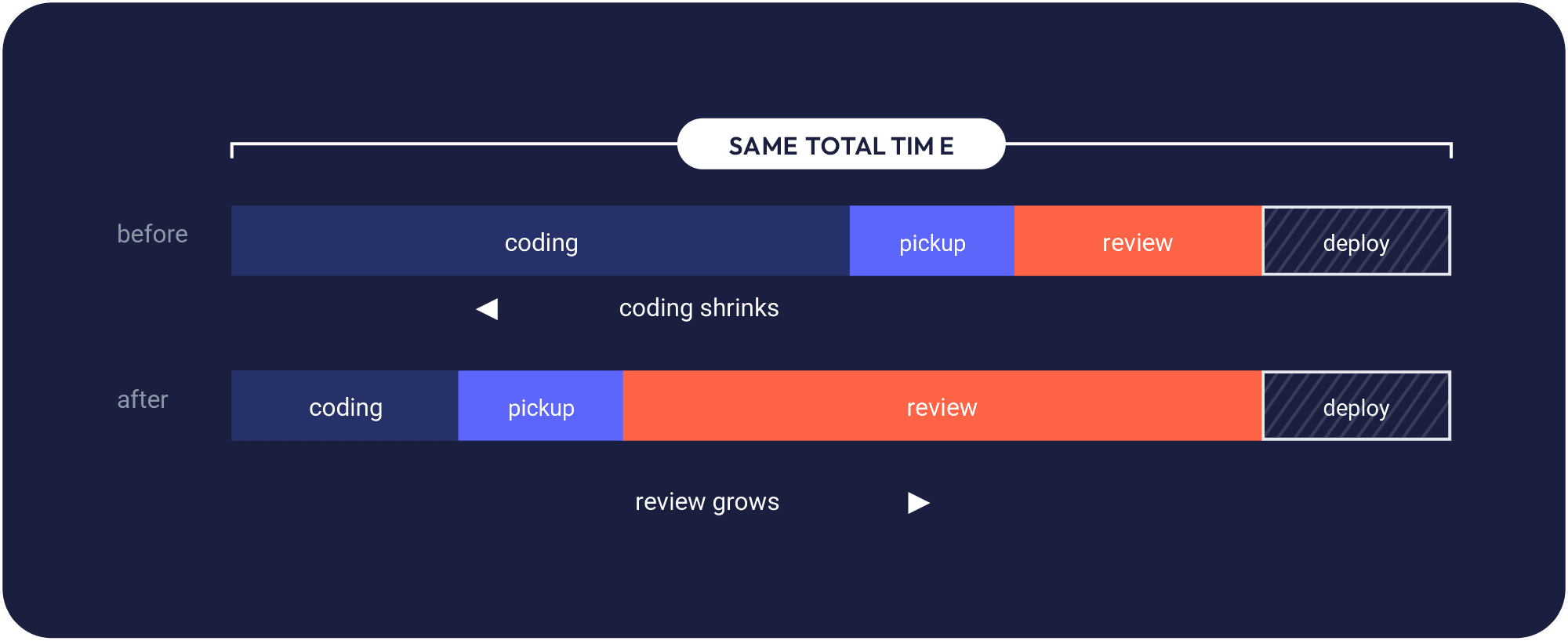
What to do next: decompose cycle time by stage every month so you can see where AI velocity gains are getting absorbed, rather than reading a flat top-line as no change.
PR yield, and who owns the work
PR yield is the share of agent-opened pull requests that get merged. Agentic pull requests merge at 37% in less mature organizations, against 81% to 90% for all pull requests, up to a 53% gap between human and agentic merge rates. The gap leads back to ownership rather than output quality. These are correlational patterns in LinearB’s benchmark data, not proof that agents cause abandoned work.

Dex Horthy
Set the policy to fit your risk. A common approach is to let an agent own a routine pull request under a single human review, while sensitive parts of the codebase require human ownership and dual review. Whatever policy you set, a context layer attributes every pull request to whoever worked it, human or agent, so the decision has something to run on.
What to do next: assign a human owner to every agent-opened PR and attribute merges by author type, so abandoned agentic work becomes visible instead of quietly draining spend.
Download your free copy of the guide
Cost per effective PR: The one metric your executives need
Predictability measures how close what you committed to comes to what you delivered. When output variability climbs, velocity turns into noise the business can’t plan against, and a roadmap stops working as a forecast. Cost per effective PR is the metric that catches spend climbing while delivered work isn’t.
Cost per effective PR = (people cost + AI spend) ÷ (PRs opened × effective yield)
Three drivers move the number. AI adoption and effectiveness asks whether people are using AI and using it well, because wasted tokens raise spend without moving delivery. Yield asks whether the pull requests agents open are shipping, because an abandoned PR is spend with no return. Quality asks whether those pull requests hold, because a PR that merges and then gets rewritten spends the budget twice.
To make it computable, push each tool’s inference spend into the layer against the PR it belongs to, read it back beside merged PRs and rework for the same period, then divide total engineering cost, people and AI together, by merged pull requests less the reworked ones. Watch for cost per effective PR rising while raw PR counts hold steady. That is spend going somewhere other than delivery.
What to do next: compute cost per effective PR once a month using your own finance number for people cost, and bring the trend, not a single reading, to your executive conversation.
Close the loop with signals from your own SDLC
Cross-platform SDLC data, pulled from tools like GitHub, Jira, and ServiceNow, is what makes the context layer useful. You can filter, sort, pivot, and label by any kind of experiment, and measure throughput by cohort across human, agentic, and assisted work. None of this has to arrive at once. Pick one loop, instrument it, and judge it against the baseline you captured on the way in. The teams furthest along added loops they could already verify, rather than rebuilding the factory in a single pass.
The move that separates a reporting tool from an operating system is putting the record in front of the work. Point an MCP client at the LinearB MCP server and your agents can query the same delivery history a human reads, so a change gets checked against your team’s review and rework norms before a PR opens. This maps to LinearB’s APEX framework, which extends DORA for the AI era across AI leverage, predictability, efficiency, and developer experience.
MCP itself is worth naming precisely. The Model Context Protocol is an open standard for connecting AI assistants to external systems, and it is how an agent reaches your delivery record on demand rather than a week later in a report.
Vanity signal vs. effective signal
The same raw metric can read as progress or hide a problem. The effective version, drawn from the context layer, is the one worth putting in front of leadership.
Signal | Reads as progress | Effective version (from the context layer) |
|---|---|---|
AI adoption | 54% of PRs use AI assistance | Effective PR yield: PRs merged minus rework, by cohort |
Cycle time | Flat top-line number | Cycle time decomposed by stage, so a moved bottleneck is visible |
Raw PR volume | More PRs opened by agents | Agentic merge rate vs. baseline (37% vs. 81% to 90%) |
AI spend | Total tokens consumed | Cost per effective PR: (people cost + AI spend) ÷ (PRs opened × effective yield) |
Each effective signal is citable on its own and traces back to the delivery record, which is what makes it defensible in an executive review.
What to do next: compose your instrumented loops into a single scheduled report, cycle time by stage, agentic yield against baseline, and cost per effective PR, and flag any planned project whose signals are moving the wrong way before it becomes a status meeting.
Frequently asked questions
What is a software factory context layer?
A software factory context layer is the system that unifies engineering signals from across your SDLC, source control, issues, CI, deploys, and AI coding tools, into one record you can trace from spec to ship. It gives a software factory the org-wide, trended evidence that individual tools can’t produce on their own.
How do you measure if AI coding tools are actually working?
Measure delivered value, not adoption. Track effective PR yield (pull requests merged minus rework), decompose cycle time by stage to see where velocity gains are absorbed, and compute cost per effective PR. Adoption rates and token counts show usage, not whether AI is improving throughput.
What is cost per effective PR?
Cost per effective PR is total engineering cost, people and AI spend together, divided by pull requests opened times effective yield. It catches the case where spend climbs while delivered work holds steady, which is spend going somewhere other than delivery.
Why do agentic pull requests merge less often than human ones?
Agentic pull requests merge at 37% in less mature organizations, against 81% to 90% for all pull requests, in LinearB’s benchmark data. The gap correlates with ownership rather than code quality: an agent-opened PR with no human owner is more likely to stall. Assigning a human owner to every PR is the common fix.
What is the difference between AI adoption and AI effectiveness?
AI adoption measures how much AI is used, such as the share of PRs with AI assistance. AI effectiveness measures whether that usage reaches delivery, through yield, quality, and cost per effective PR. High adoption with low effectiveness is the signature of wasted spend.
Take your first step toward a feedback loop you can trust
Software factories are the operating frame now, whether or not a team has named it yet, and where this goes next is uncertain. What holds up inside that uncertainty is the feedback loop: seeing what changed and getting it back into the next decision fast enough to matter. LinearB shows you what your factory shipped, attributed at pull-request level across your AI tools, computes your cost per effective PR, and works wherever the decision happens, through the APIs, custom metrics, or the MCP server in your agent’s own session.
See what your factory shipped: start a free trial, or book a demo.
By Dan Lines, Co-Founder & COO, LinearB
