The AI code review bottleneck: why AI code waits 5x longer

Summary
- Agentic AI pull requests wait 5.3x longer for a reviewer than unassisted ones: 17.6 hours vs 3.4 at the 75th percentile (LinearB 2026 Benchmarks Report).
- Only 32.7% of AI-generated pull requests are accepted, against 84.4% for human-written ones, and the fixing lands on the senior engineers with context.
- 66% of developers name almost-right AI output as their biggest frustration; 45% say debugging AI code takes longer (Stack Overflow 2025 Developer Survey).
- Keep your best reviewers fluent by protecting hands-on coding time, and measure it with a quarterly developer survey.
- Give every agent-authored pull request a named human owner at task assignment, and automate approval for safe and tiny changes.
The AI code review bottleneck is the point where AI-generated code piles up waiting for a human with enough context to approve it. According to LinearB's 2026 Software Engineering Benchmarks Report, agentic AI pull requests wait 5.3x longer for a reviewer than unassisted ones (17.6 hours against 3.4 hours at the 75th percentile), and only 32.7% of AI-generated pull requests are accepted, against 84.4% for human-written ones. AI changed the shape of the work as well as its volume, so your engineers write less of the code they ship and spend more of their day reading, checking and correcting code a model wrote first.
This guide shows you where that review load lands in your engineering data, who ends up carrying it, and the two changes that take the weight off them: keeping your best reviewers fluent, and giving every agent-authored pull request a human owner. The data comes from the 2026 Software Engineering Benchmarks Report and LinearB's 2026 leadership survey. Updated November 2026.
The AI code review bottleneck is the queue that forms when AI tools generate pull requests faster than the engineers with context can review them. It shows up in your git data as rising pickup time and falling acceptance rate for agentic pull requests, weeks before it shows up in delivery.
Download your free copy of the guide
The review queue is your software factory's new bottleneck
As AI output climbs, review load concentrates on the people with the context to judge each change, and the bottleneck appears in your engineering data well before it shows up in delivery. Three numbers describe the shift. According to LinearB's 2026 Software Engineering Benchmarks Report, 32.7% of AI-generated pull requests are accepted, against 84.4% for human-written ones. According to a Fastly developer survey reported by TechCrunch, more than 95% of developers spend extra time fixing AI-generated code. And according to researcher Annie Vella, 77% of engineers spend less time writing code than they used to.
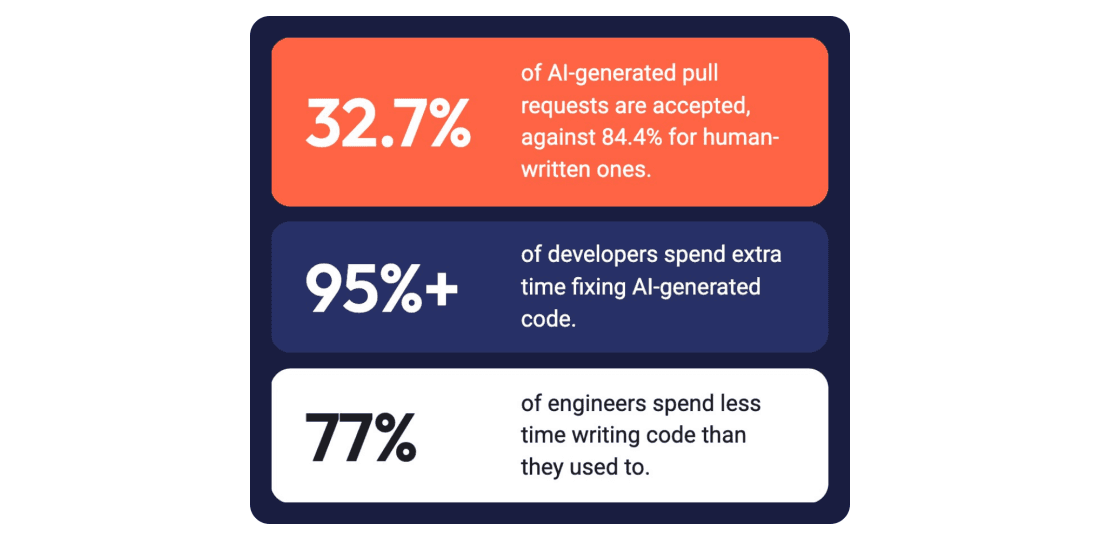
Everyone is measuring how much code AI writes. Almost nobody is measuring who is stuck reading it. Your delivery metrics can look healthy on a dashboard while a few senior engineers hold the whole process up, because a human review policy on every merge means someone is on the floor reading all of it. If you are building toward a dark factory, where agents write the code and policies decide what merges, that someone is the constraint your software factory runs on today.
What to do next: pull pickup time and acceptance rate for agentic pull requests, team by team, and set them beside the same numbers for manual work. The gap between the two is the size of your bottleneck.
Your engineers now review code no teammate wrote
AI flipped the balance of an engineer's day: the part they came for, writing code, shrinks, and the part they tolerated, reviewing it, fills the schedule. According to the Stack Overflow 2025 Developer Survey, 66% of developers name AI output that is almost right, but not quite, as their biggest frustration, and 45% say debugging AI-generated code is more time-consuming than debugging their own, the second-biggest frustration in the survey.
The code under review is no longer a teammate's either. A teammate's pull request comes with context and someone to ask when that context is missing. A model's pull request leaves your reviewer to reconstruct its intent alone. Developers describe the change in plain terms:
- "Coding used to be about problem-solving and craft; now it's just endless mind-numbing code review for a machine that regurgitates slop faster than anyone can properly audit it." (A developer on r/techbootcamp)
- "There's no more dopamine from solving a problem by myself. The AI just figures it out." (Elvis Kimara, engineer, via TechCrunch)
- "I was just a code reviewer and a quality assurance tester for the features the coding harness would spit out." (Brett Chalupa, 20 years of coding, brettcodes.com)
The shift lands differently depending on why someone became an engineer. People who came to design and build tend to thrive, because AI puts more within their reach. People who came for the craft of writing code have lost much of the work they chose, and they include your strongest engineers. Both groups sit inside the same delivery numbers, so a factory can look healthy on a dashboard while a few of them hold it up. The same pattern shows up in LinearB's guide to an AI strategy that prevents engineering burnout.
What to do next: ask your engineers, on a schedule, whether the review process still fits the work. Your git data shows where work queues; only a survey tells you why.
Keep your best reviewers fluent
Engineers who keep writing code stay fluent enough to catch what the models get wrong. Annie Vella's guidance for leaders is to let engineers swing between deep technical work and orchestration rather than parking them in review. Move your strongest engineers into review full time and you trade a short-term throughput gain for reviewers who slowly lose the context that made them worth routing to.
What to watch
Start from the bottleneck you can already see in your git data, then use developer surveys in LinearB to ask about it directly, on a regular schedule. If review feels heavy, ask whether the process fits the workflow. If deadlines are tight, ask whether quality standards are holding. If a question scores low on every team, the fix is in your process. If one team scores low across the board, start with a conversation with that team.
What to change
Protect blocks of hands-on coding time for the engineers you lean on most for review. Treat review fluency as a capability you maintain, in the same way you would maintain an on-call rotation.
How you'll know it worked
Run the same survey before and after the change. Scores on the questions you chose improve from one quarter to the next, and the engineers who asked for hands-on coding time say they are getting it.
What to do next: pick three survey questions about review load and process fit, and schedule them quarterly before you change anything, so the baseline exists.
Download your free copy of the guide
Your engineers answer for code they never authored
A developer who writes code understands it end to end and takes pride in maintaining it. Approving something a model wrote carries the same accountability with far less of that sense of ownership. As engineer Nazar Boyko puts it, you may not own a line of the generated code, but "you're still on the hook for every bug it ships."
The cost is clearest when nobody owns the work at all. According to LinearB's 2026 Software Engineering Benchmarks Report, agentic AI pull requests wait 5.3x longer for pickup than unassisted ones: 17.6 hours at the 75th percentile against 3.4 hours. That is more than 17 hours before anyone starts reviewing, and the first cause LinearB traced is that no one was asked to. AI-assisted pull requests are also 2.6x larger than unassisted ones in the same data set.
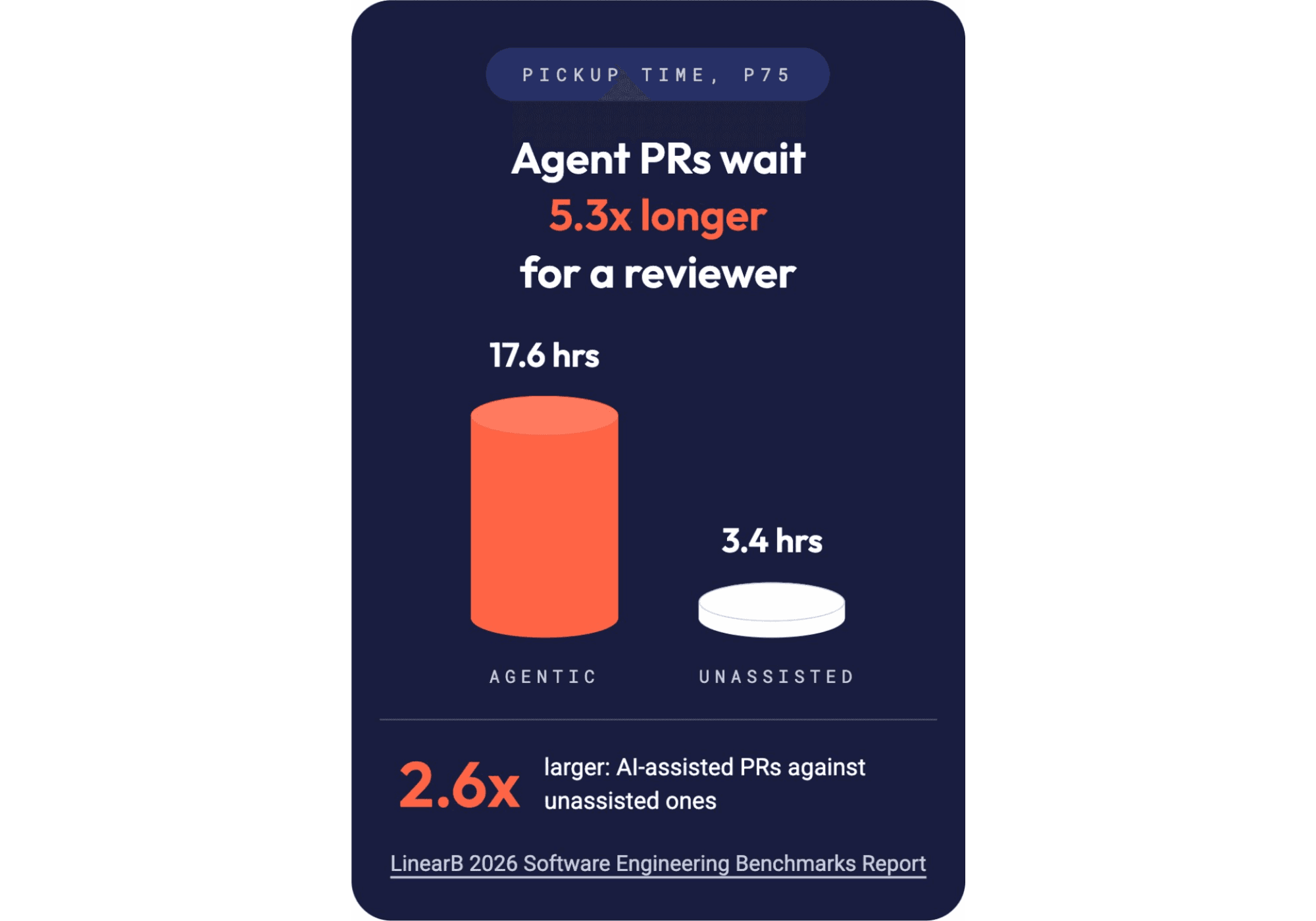
Agentic pull requests also merge at a lower rate, and LinearB traced that gap to three causes: unclear ownership, agentic flows pointed at low-priority backlog work, and reviewer hesitation on larger, more complex AI pull requests. For a wider look at the merge-rate gap, see LinearB's research on managing bot-generated pull requests and the pickup time metric itself.
What to do next: list every agentic pull request open for more than 30 days and check whether a named human owns it. Expect the unowned ones to be the oldest.
Give every agent-authored pull request a human owner
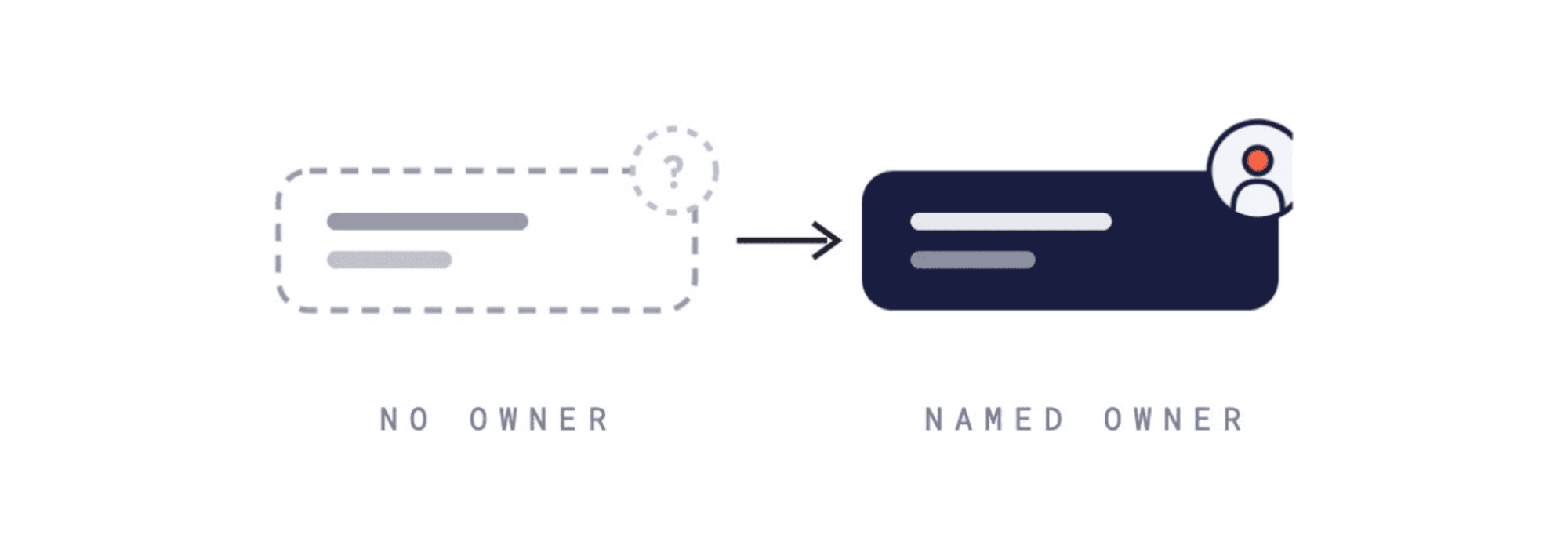
An agent can open a pull request, but it cannot argue for it in review or chase it to merge. That job needs a person, and naming them up front keeps agent work from sitting in the queue.
What to watch
Acceptance rate (the share of pull requests merged within 30 days) and pickup time for agentic work, team by team, set against the same measures for your manual work. LinearB attributes every pull request to who worked it, human or agent, so the two sit side by side and a slipping team stands out. The engineering metrics behind that comparison are the same ones your delivery reporting already uses.
What to change
Set the owner when the agent's task is assigned, so the pull request lands with someone already on the hook. At Warp, CEO Zach Lloyd has an agent own a routine pull request under a single human review, while sensitive parts of the codebase need human ownership and dual review, as he told Dev Interrupted. For low-risk agent changes, gitStream automations such as Approve safe changes and Approve tiny changes clear them without waiting for pickup, while Review sensitive files and Additional review for large PRs keep humans on the rest.
How you'll know it worked
Acceptance rate on agentic pull requests moves closer to your manual rate, and fewer agentic pull requests sit open past 30 days.
What to do next: write the ownership rule into the agent's task template this week: no agent-authored pull request opens without a named human owner.
Download your free copy of the guide
Old approach vs. fixing the AI code review bottleneck
| Question | Old approach | What this guide changes |
|---|---|---|
| What you measure | How much code AI writes (adoption, suggestions accepted) | Who reads it: pickup time and acceptance rate for agentic vs. manual pull requests, by team |
| Who reviews | Whoever is senior enough to catch the mistakes, full time | Reviewers who keep writing code, with protected hands-on time |
| Who owns agent work | Nobody, until it stalls | A named human, set when the agent's task is assigned |
| Review depth | Human review on every merge | Automated approval for safe and tiny changes; human and dual review on sensitive files |
| How you know | Delivery metrics, after the fact | Agentic acceptance rate moving toward the manual rate, and survey scores improving quarter over quarter |
The left column measures output. The right column measures the people absorbing it, which is where the bottleneck lives.
Frequently asked questions
Why do AI-generated pull requests wait longer for review?
AI-generated pull requests wait longer because no one is assigned to them, agentic flows point them at low-priority backlog work, and reviewers hesitate on larger, more complex changes. According to LinearB's 2026 Software Engineering Benchmarks Report, agentic pull requests wait 5.3x longer for pickup than unassisted ones (17.6 hours against 3.4 hours at the 75th percentile) and are 2.6x larger.
What is the acceptance rate of AI-generated code?
32.7% of AI-generated pull requests are accepted, against 84.4% for human-written ones, according to LinearB's 2026 Software Engineering Benchmarks Report. Acceptance rate is the share of pull requests merged within 30 days of opening.
How do I measure the AI code review bottleneck?
Measure pickup time and acceptance rate for agentic pull requests, team by team, against the same two numbers for manual pull requests. A widening gap between the two is the bottleneck. LinearB attributes every pull request to its author type, human or agent, so the comparison runs on your own data.
Should AI-generated pull requests have a human owner?
Yes. An agent can open a pull request, but it cannot defend it in review or chase it to merge, so unowned agent work sits in the queue. Set a named human owner when the agent's task is assigned, and use automated approvals for safe or tiny changes so the owner's attention goes to the changes that need judgment.
How does AI code review affect senior engineers?
Verification load concentrates on senior engineers, because they have the context to judge what a model produced. According to a Fastly survey reported by TechCrunch, more than 95% of developers spend extra time fixing AI-generated code. Moving senior engineers into review full time costs you the fluency that made them good reviewers, so protect their hands-on coding time instead.
Find who is holding up your AI-generated code
Review load, agent wait time and weekend work all leave a trace in your git data before they show up in delivery. The next step is finding them: four signals your team is absorbing AI's hidden cost turns this strain into four measurable signals on the engineering health dashboard, with a scorecard to pick where to start, and six questions to ask your engineering data gives you the exact questions to run through the LinearB MCP server.
See how your people are holding up in the same place you see your delivery: book a demo.
Foreword by Yishai Beeri, CTO, LinearB.
